
Winter Boat Storage for Old Hickory Lake and Barren River Lake
Winter boat storage is the quiet half of the boating year, and it shapes how your boat starts next spring. Rubright Marinas keeps boats through the closed season at four marinas: two on Old Hickory Lake near Nashville and two on Barren River Lake in Kentucky. Some sit on dry racks, one building keeps every boat indoors, and slip holders stay tied up at floating docks.
This page covers where your boat can spend the cold months, when each marina closes, and what to do to the engine, the fuel and the water systems before the first hard frost.
How winter boat storage works at our marinas
Storage carries on after the fuel docks and stores shut for the season. A storage agreement is about where the boat lives, and the boat stays put while the marina is closed to visitors. What changes in winter is access: launches, fuel and store hours stop, and the corporate office becomes the place to call.
Dry racks through the closed season
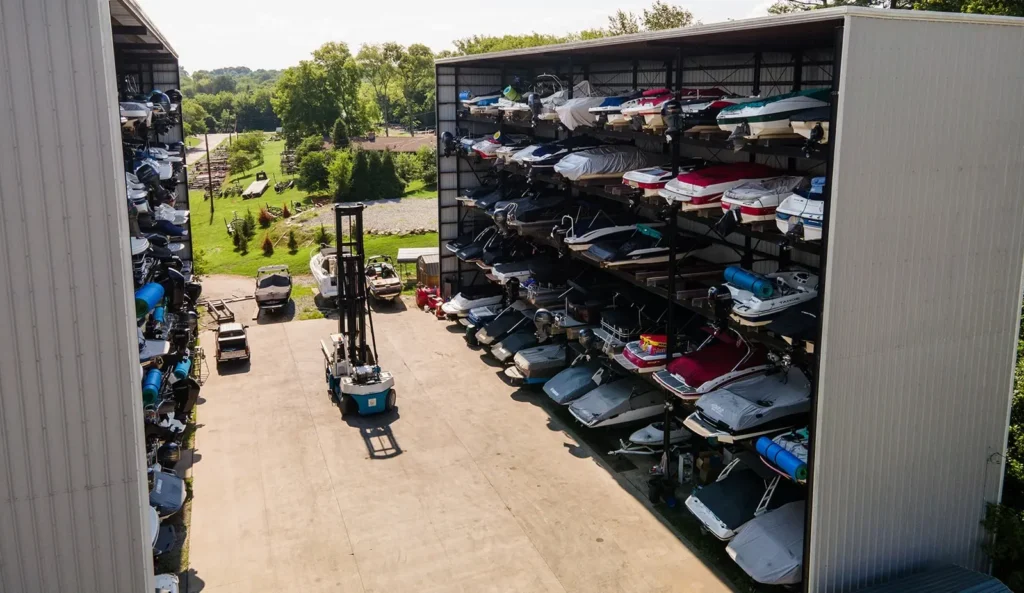
A racked boat stays on its rack until spring. It sits out of the water the whole time, so there is no hull growth, no ice against the gelcoat and no bilge pump working through a cold snap. Dry stack storage runs at our two Tennessee locations: Gallatin Marina, and over in Mount Juliet, The Boathouse at Benders Ferry. If your boat already lives on a rack with us, winter needs nothing new from you apart from getting the engine ready.
Slips over the winter
Boats in slips stay in the water. Our docks float, so they rise and fall with the lake instead of leaving a boat hanging or grounded when the level drops. A boat that stays afloat over winter does need more preparation than a racked one, because the hull, the drive and any raw water plumbing are sitting in cold water for months. Where the slip is covered, as at Gallatin, Peninsula and the state dock, the roof at least keeps snow and ice off the deck.
Indoor winter boat storage at The Boathouse
Our Mount Juliet location, The Boathouse at Benders Ferry, stores boats on racks inside an enclosed building. For anyone looking for indoor winter boat storage near me on the east side of Nashville, that is the simplest answer we have. Snow, freezing rain and the low winter sun stay off the boat completely, and canvas and vinyl come out of the season looking the way they went in.
Indoors still does not mean frost free. A roof and walls keep weather off, but they do not stop water inside an engine from freezing on a cold night, so the engine still needs winterizing just as it would on an outdoor rack. Call The Boathouse on 615-758-2999 to ask about space for next season.
When each marina closes for the season
Closing dates differ by lake. The Kentucky marinas close first. Barren River State Dock and Peninsula Marina close from October 16th and reopen on April 15th. Gallatin Marina and The Boathouse on Old Hickory Lake stay open through November, close on December 1st, and reopen on April 1st. The full seasonal schedule for every location sits on our marina hours page.
Those dates matter for planning. If you want the marina staff to look at your boat or talk through winter prep in person, do it while the marina is still open. After closing, the corporate office at Gallatin Marina answers the phone on weekdays from 9 AM to 5 PM, all year, on 615-452-9876.
How to winterize a boat before the cold sets in
Middle Tennessee and south central Kentucky get hard freezes most winters, and water left inside an engine or a hose expands when it freezes. That is how a cracked block or a split manifold happens. Knowing how to winterize a boat comes down to four jobs: protect the engine, treat the fuel, empty the water systems and look after the battery. Your owner’s manual has the exact steps for your engine, and it is the document to follow.
Engine and cooling system
Change the engine oil and filter before storage rather than in spring. Used oil holds acids and moisture that sit against bearings all winter. On an inboard or sterndrive, the raw water cooling system has to be drained or filled with a marine antifreeze made for engines, following the manual. Outboards drain themselves when tilted down to vertical, which is why they should be stored that way.
Check the lower unit gear oil too. If it comes out milky, water has found its way past a seal, and that is far better found in November than in May. Many owners also fog the engine, spraying fogging oil into the intake so the cylinders keep a protective film while the boat sits.
Fuel and the tank
Fill the tank close to full before storage, so less damp air sits above the fuel. Add a marine fuel stabilizer at the dose on the bottle and run the engine long enough to pull treated fuel through the lines. Our docks pump 100 percent ethanol free gasoline with Primrose Fuel Additives, which helps, because ethanol blends absorb water as they sit. Even ethanol free gas ages over months, though, so stabilizer is still worth adding.
Water systems, battery and the cabin
Drain every place water collects: livewells, baitwells, washdown lines, sinks, a freshwater tank and the water heater if the boat has one. Pump the bilge dry. Charge the battery fully and either take it home or disconnect it, since a flat battery can freeze. Take out electronics you can remove, wet towels and anything that will grow mildew, and prop hatches or lockers open slightly so air moves.
Winterizing a pontoon boat
Pontoons are simpler underneath but carry more upholstery. Anyone asking how to winterize a pontoon boat should start with the outboard, which follows the same steps as any outboard above. Then turn to the deck. Lift or remove the seat cushions so they dry, clear leaves and debris out of the corners, and check the logs for dents or loose fittings while you can see them.
If the pontoon has a livewell, a sink or a freshwater shower, drain each one. A good fitted cover keeps rain and leaves off the furniture, but leave a little ventilation so condensation does not build up underneath it. Whether a particular pontoon can go on a dry rack depends on its length and beam, so call with the measurements.
Boat winterization: what to ask our staff
Boat winterization is something many owners do themselves and many prefer to hand to a mechanic. Either way, our staff are a good first conversation. Talk to the team at your marina well before the first hard frost. They know the lake, they know which boats tend to give trouble, and they can walk you through what your particular engine and water lines will want, along with any help available at the marina.
Bring the make, model and year of the engine, and mention anything unusual, such as a generator, an air conditioner or a ballast system on a wake boat. Each of those has its own water to drain.
Winterizing a boat that stays in the water
Both of our lakes are drawn down through winter to hold room for flood water, then filled back up in spring. A floating dock handles that without any help from you. What does need attention is the boat itself. Check that the bilge pump works and that the battery feeding it stays charged, keep lines adjusted with enough slack for the level change, and visit now and then after storms. Winterizing a boat in a slip is the same job as on a rack, with extra care for anything below the waterline.
Getting the boat back in spring
The work you do in fall pays off on the first warm weekend. A boat that was put away with fresh oil, treated fuel and a charged battery usually starts on the first try. Reverse the steps in your manual: reconnect the battery, refill any systems you drained, check belts and hoses, and run the engine at the dock before heading out. Our Old Hickory marinas reopen on April 1st and the Kentucky marinas on April 15th, and the spring rush for launches and fuel starts soon after.
Finding winter boat storage near me from Nashville or Bowling Green
When people search for boat winter storage near me, what they really want is a place that fits the drive and the boat. From north Nashville, Hendersonville or Gallatin, Gallatin Marina is the closest of our four. From Hermitage, Lebanon or East Nashville, The Boathouse at Benders Ferry is usually quicker. Boaters from Bowling Green and Glasgow tend to choose Barren River Lake, where Peninsula Marina and Barren River State Dock both have slips. Our boat storage page compares every option side by side.
Frequently asked questions
Can I keep my boat at the marina after it closes for the season?
Yes. Boats in storage stay where they are through the closed season. Racked boats stay on their racks, and boats in slips stay at the floating docks. What stops is launching, fueling and store service until the marina reopens.
Is indoor winter storage available?
Yes. At The Boathouse at Benders Ferry, our Mount Juliet marina, boats are racked inside an enclosed building. The engine still needs winterizing before the cold arrives.
Do I still need to winterize a boat stored indoors?
Yes. A roof keeps weather off the boat, but it does not stop water inside the engine or plumbing from freezing on a cold night. Prepare the engine, fuel, water systems and battery the same way you would for outdoor storage.
When should I start winterizing?
Before the first hard frost and while your marina is still open, so you can talk to the staff in person. The Kentucky marinas close from October 16th and the Tennessee marinas from December 1st.
Who do I call during the winter closure?
The corporate office at Gallatin Marina, open Monday to Friday from 9 AM to 5 PM all year, on 615-452-9876. The team can pass your question to the right marina.
To talk about winter boat storage for next season, call 615-452-9876 or send a message through our contact page.